
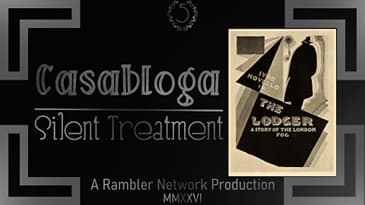
The Lodger: A Story of the London Fog is a 1927 thriller directed by Alfred Hitchcock and starring Ivor Novello, June Tripp, and Marie Ault. Even though he directed two films before this, even Hitchcock himself felt this was the "first true Hitchcock film".
Alfred Hitchcock | The Lodger - A Story of the London Fog | 1927
[00:00:03] Step right up ladies and gents, a show for the ages, a spectacle of silent silver. Gather round folks, don't be shy. A real humdinger of a picture of eight, thrills, chills, and plenty of laughs. From the golden days of flickering reels and grand Nickelodeons comes a program most extraordinary. A real corker of a show, a top notch talkie about a world with no talk at all. It's Casabloga Silent Treatment.
[00:00:42] Before Alfred Hitchcock made Psycho, Vertigo, Rear Window, or North by Northwest, he directed a silent thriller called The Lodger. And while his style wasn't fully formed yet, you'll probably recognize it almost immediately. The story begins as London is gripped by fear. A serial killer known only as the Avenger is targeting young blonde women. Just as panic spreads through the city, a mysterious man arrives at a boarding house looking for a room.
[00:01:10] He's quiet and secretive, and only goes out at night. Before long, everyone begins wondering the same thing. Could this be the Avenger? What surprised me most about The Lodger wasn't the mystery itself. Instead, it was how modern the film feels. There were moments when I found myself thinking, this feels like a Hitchcock shot. Then I'd immediately remember, well, of course it does. This is Hitchcock.
[00:01:37] Throughout the film, you can already see many of the visual techniques that would define his career, such as the careful framing, the use of staircases and doorways, and the way ordinary rooms suddenly feel threatening simply because of how they're photographed. There was even one scene where a character was taking a bath while a closed door sits in the background. Knowing the lodger was on the other side of the door, I kept expecting it to slowly open, just like that one scene from Psycho.
[00:02:05] Nothing happens, but it's remarkable how similar the visual language already feels over 30 years earlier. Another thing that stood out was how confidently Hitchcock tells the story without relying on intertitles. Coming right after the last laugh, I couldn't help noticing how much information was communicated purely through images. I mean, there are intertitles, but they are used sparingly.
[00:02:28] When the lodger first arrives, he and the landlady have an entire conversation without a single title card. He notices the room for rent. She understands what he's asking and leads him upstairs. He inspects the room and decides to rent it. The audience understands every step without anyone needing to explain it. That's something modern audiences often underestimate about silent films.
[00:02:55] The best filmmakers understood that cinema is a visual medium first. One small detail I always enjoy looking up in historical films is the cost of everyday things. Whenever someone mentions a price, I end up reaching for an inflation calculator. The lodger rents his room for £2.10 a week. Adjusted floor inflation, that's roughly £40 a week. Then, without hesitation, he throws down two £5 notes and pays a month's rent in advance.
[00:03:23] In modern terms, that's almost £200 in cash. It immediately tells you something about him. He's carrying a surprising amount of money, and he wants the room without asking questions or attracting attention. That kind of visual storytelling appears throughout the film. Hitchcock constantly gives this information without stopping the story to explain it. From this point on, I will be discussing spoilers.
[00:03:51] The first thing I guessed while watching turned out to be correct. The lodger felt almost too suspicious. Every clue kept pointing toward him so directly that I kept thinking he had to be a red herring. What I didn't expect was just how little the identity of a real killer would matter. I assumed the ending would build towards the Avenger attacking Daisy, followed by the lodger rescuing her in a final confrontation.
[00:04:20] Instead, the real murderer was captured off-screen. At first, that surprised me. Then I realized the film was never really about solving the murders. It was about suspicion. Once the crowd becomes convinced they've found the killer, evidence no longer matters. The lodger is strange, quiet, and secretive. That's enough. Watching the ending actually reminded me of the catcher of Richard Ramirez. Nearly 60 years later, when people recognized Ramirez from the news,
[00:04:47] ordinary citizens chased him through the streets, beat him, and held him until police arrived. The difference, of course, was that Ramirez actually was guilty. In the lodger, the mob has the wrong guy. That shifts the focus away from the serial killer and towards something arguably more frightening. How quickly fear can convince ordinary people they've already found the answer. It's a surprisingly timeless message. In fact, a similar idea appears in Halloween Kills,
[00:05:13] when a terrified crowd mistakes an innocent patient for Michael Myers and ultimately causes his death. Looking back now, it's fascinating to watch Hitchcock before he became Hitchcock. You can already see the recurring ideas that would define his career. The innocent man under suspicion. Suspense building through framing instead of dialogue. Architecture used to create tension. Even simple staircases and doorways become sources of unease.
[00:05:44] While later films would refine these techniques to perfection, the lodger remained an engaging thriller in its own right, and an important milestone in film history. If you've only seen Hitchcock's famous sound films, this is absolutely worth seeking out. And... cut! Step right up, folks! Don't let the show end here.
[00:06:11] If you enjoyed tonight's picture, there's plenty more waiting just beyond the curtain. Follow the show on Instagram at ramblernetwork. And for even more stories that spot curiosity, step right this way to ramblernetwork.com, your one-stop destination for all things Rambler Network. So don't be a stranger and miss the next attraction, because the show is always just getting started. The Rambler Network.