
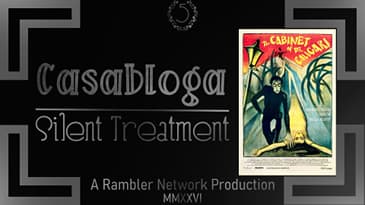
The Cabinet of Dr. Caligari is a 1920 horror film directed by Robert Wiene and starring Werner Krauss, Conrad Veidt, and Hans Heinrich von Twardowski. It is a very influential example of German Expressionism.
[00:00:03] Step right up ladies and gents, a show for the ages, a spectacle of silent silver, gather around folks, don't be shy, a real humdinger of a picture of eight, thrills, chills, and plenty of laughs
[00:00:24] From the golden days of flickering reels and grand Nickelodeons comes a program most extraordinary, a real corker of a show, a top-notch talkie about a world with no talk at all, it's Casabloga, Silent Treatment Before Alfred Hitchcock made audiences question who the killer was, and before Hollywood was filling theaters with vampires, monsters, and mad scientists
[00:00:52] Once silent films showed that horror didn't need any of those things Sometimes the scariest place you can visit is the human mind Released in 1920, The Cabinet of Dr. Caligari is one of the best examples of German Expressionism ever made It's also one of the most influential More than a century later, filmmakers are still borrowing ideas from it, whether they realize it or not
[00:01:17] The story begins at a carnival where a mysterious showman named Dr. Caligari exhibits his greatest attraction A sleepwalker named Caesar Who has supposedly been made asleep for 23 years According to Caligari, Caesar can answer any question about the future But shortly after the carnival arrives, a series of murders terrorizes the town And suspicion quickly falls on the strange guy who only awakens at his master's command
[00:01:47] If you watch this after watching The Lodger like I did, you find yourself expecting another mystery where the obvious suspect turns out to be innocent That isn't what this film is interested in Instead of asking who committed the murders, the Cabinet of Dr. Caligari asks a far stranger question Can you trust what you're seeing at all? The first thing you'll notice is that this movie doesn't look like reality
[00:02:14] Buildings lean at impossible angles Streets twist unnaturally Windows are crooked Even the shadows aren't real They're painted directly onto the sets Today, it almost looks like someone built an entire movie inside a Tim Burton sketchbook But There was a reason for all of it The film is the defining example of German expressionism An artistic movement that wasn't concerned with showing the world as it really looked Instead
[00:02:43] It wanted to show the world as it felt Rather than realistic streets and buildings, everything is distorted Creating the feeling that something is wrong long before anything frightening actually happens That visual style would go on to influence countless horror films Especially the Universal Monsters And the 1930s You can also see traces of it in filmmakers like Tim Burton, Guillermo del Toro
[00:03:10] And even some of the dreamlike sequences in modern psychological thrillers Of course, the film's biggest talking point is its ending Without giving away every detail The story eventually reveals that things may not be what they appear to be The final scenes completely change how you view everything that came before them Whether that twist means the events never happened Or whether the ending itself should be questioned Has been debated by audiences and film historians for over 100 years
[00:03:38] Part of that debate exists because the original screenplay ended differently The framing story that shrouded the main plot was added before the film was released Some critics believe it weakens the original message about authority While others argue it creates an even more fascinating psychological puzzle Whatever interpretation you prefer It's remarkable that a movie from 1920s still sparks discussions today
[00:04:04] What surprised me most was how committed it was to a Dawn vision We've all seen stylized movies before But most of them still have one foot planted in reality The cabinet of Dr. Caligari Abandons reality almost immediately and never looks back After a few minutes, the crooked buildings and painted shadows stop feeling strange They simply become the world you're living in Even the intertitles have a bizarre surrealistic feel to them
[00:04:31] Looking unlike any intertitles I've seen in any other silent film It's one of those rare films where the setting becomes a character After watching The Lodger immediately beforehand The contrast is fascinating Hitchcock's film already felt surprisingly modern Using realistic locations and suspense that wouldn't feel out of place decades later Caligari, despite being 7 years older Goes in a completely different direction
[00:04:59] It's less interested in realism than emotion Less interested in solving a mystery than making you question reality itself Both films are landmarks But they represent two completely different paths that cinema could have taken The cabinet of Dr. Caligari may not be frightening by today's standards But its importance is impossible to overstate It helped establish horror as a cinematic art form Introduced visual storytelling techniques that filmmakers still borrow today
[00:05:29] And prove that sometimes the most memorable special effect isn't a monster It's simply painting the world to look like a nightmare And cut Step right up, folks Don't let the show end here If you enjoyed tonight's picture There's plenty more waiting just beyond the curtain Follow the show on Instagram at ramblernetwork
[00:05:57] And for even more stories that spot curiosity Step right this way to ramblernetwork.com Your one-stop destination for all things Rambler Network So don't be a stranger and miss the next attraction Because the show is always just getting started The Rambler Network ем in the room