
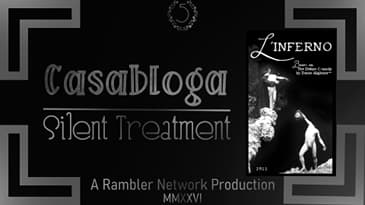
Dante's Inferno (L'inferno) is a 1911 horror film directed by Francesco Bertolini and starring Salvatore Papa, Arturo Pirovano, and Emilise Beretta.
L'Inferno (Dante's Inferno) 1911 | Colorized | Divine Comedy | FULL MOVIE | English
[00:00:03] Step right up ladies and gents, a show for the ages, a spectacle of silent silver, gather around folks, don't be shy, a real humdinger of a picture of eight, thrills, chills, and plenty of laughs
[00:00:24] From the golden days of flickering reels and grand Nickelodeons comes a program most extraordinary, a real corker of a show, a top-notch talkie about a world with no talk at all, it's Casabloga Silent Treatment When people think of the earliest movies, they usually imagine short films of people leaving factories or trains arriving at stations
[00:00:49] Even when films began telling stories that were often only a few minutes long So imagine my surprise when I sat down to watch the feature-length fantasy film from 1911 and was immediately greeted by color Well, sort of L'Inferno Based on the infernal section of The Divine Comedy More commonly referred to as Dante's Inferno
[00:01:19] Follows Dante as he's guided through the circles of hell by the Roman poet Virgil Together they encounter souls being punished for their sins, each receiving a punishment that reflects the life they lived Now, before watching this, I had never actually read Dante's Inferno I knew the basics Dante goes to hell That's about it So I spent the first few minutes wondering Wait, is Dante just visiting?
[00:01:49] As it turns out, yes He's basically taking the least appealing guided tour in literary history Personally, I wouldn't want to take a guided tour through hell, but to each their own, I guess One thing that surprised me almost immediately was how ambitious this film is The version I watched preserved the original hand-colored effects And seeing a movie from 1911 with scenes of lush green wasn't something I expected at all
[00:02:17] Then came the special effects Ghostly spirits floated through the air Massive demons towering over tiny human figures Monsters appear and disappear through double exposures and clever camera tricks Watching this, I kept reminding myself this was made in 1911
[00:02:38] These effects obviously don't fool modern audiences, but they're remarkably imaginative and it's easy to understand why people at the time would have been amazed And then there was another surprise Well, actually several surprises The film contains full nudity Presented in the style of classic religious artwork It depicts one of the most controversial passages from Dante's poem
[00:03:05] Including his depiction of Muhammad with his chest ripped open It certainly isn't the kind of film most people picture when they think of silent cinema If anything, Inferno constantly reminded me that early filmmakers were far more ambitious than I had expected Unfortunately, I also found myself becoming increasingly bored And I don't think that's entirely the film's fault
[00:03:34] The problem is that Dante's Inferno is structured as a journey Dante and Virgil travel from one circle of hell to another Meeting different souls and witnessing different punishments That works well in poetry, but as a 70-minute film, it becomes rather repetitive This group suffers Now this group suffers And over here These people suffer too The visuals continue to impress
[00:04:03] But dramatically, the film never really builds momentum There's no mystery to solve or emotional storyline to follow It's simply just a tour through hell Ironically, I think Inferno demonstrates both why feature films became possible And why filmmakers still had to learn how to pace them That doesn't diminish what it accomplished though In many ways, Inferno feels like a bridge between two eras of cinema
[00:04:29] Towards Milliers had already shown that movies could create magic through visual effects Inferno expanded that idea into a feature-length spectacle Proving audiences would sit through an ambitious fantasy film built around elaborate special effects It's an important step towards the epic films that would follow throughout the silent era Did I enjoy it? Not particularly Did I admire it? Absolutely
[00:04:59] Sometimes those are two different things Inferno isn't a film I'd rush to watch again But I am genuinely glad I experienced it It challenged nearly every assumption I had about what a movie from 1911 could be Between the hand-colored imagery, surprisingly sophisticated effects, and sheer scale of the production It became one of the most historically fascinating films we've covered this season It may not have completely held my attention
[00:05:26] But over a century later, it's still capable of surprising its audience And cut! Step right up, folks Don't let the show end here If you enjoyed tonight's picture, there's plenty more waiting just beyond the curtain Follow the show on Instagram at ramblernetwork And for even more stories that spot curiosity Step right this way to ramblernetwork.com
[00:05:53] Your one-stop destination for all things Rambler Network So don't be a stranger and miss the next attraction Because the show is always just getting started The Rambler Network