
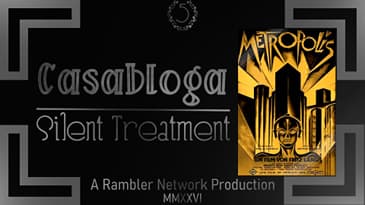
Metropolis is a 1927 German expressionist science-fiction silent film directed by Fritz Lang and starring Gustav Fröhlic, Brigitte Hel, and Alfred Alfred Abel. It was based on Metropolis by Thea von Harbou.
[00:00:03] Step right up ladies and gents, a show for the ages, a spectacle of silent silver, gather around folks, don't be shy, a real humdinger of a picture of eight, thrills, chills, and plenty of laughs, from the golden days of flickering reels and grand Nickelodeons comes a program most extraordinary, a real corker of a show, a top-notch talkie about a world with no talk at all, it's Casabloga Silent Treatment
[00:00:42] When people talk about historically important movies, there's sometimes an assumption that historically important automatically means entertaining. It does not. I've watched plenty of movies that I completely understand are important to film history, while also desperately waiting for them to end. The Birth of a Nation and Intolerance were both enormously significant films, I also had to fight the urge to fall asleep during both of them.
[00:01:08] Metropolis is different. I appreciate what it accomplished in 1927, but I also genuinely love this movie. And considering I technically started watching Metropolis about 15 years ago, it took me a while to figure that out. Back then, I was used to silent films being relatively short, so one night around 11 o'clock I decided to start Metropolis, without checking the runtime, which was a mistake.
[00:01:33] I fell asleep pretty early into the film and remembered essentially nothing. So when I finally came back for this season of Casabloga, I basically was watching it for the first time. Within about 8 minutes, I was already impressed. Even the opening title animation caught my attention. Throughout this season, I've seen plenty of silent films where the title is basically what you'd expect, a static title card.
[00:02:04] Metropolis opens with an animated title sequence. It's a tiny thing compared to everything the movie is about to do, but immediately I thought, okay, that was different. The first thing we see after that is a shift change. Hundreds of workers move together in perfect synchronization, heads lowered, marching into these enormous elevators that carry them deep underground.
[00:02:27] The sheer scale of production immediately becomes apparent. The workers don't really move like individual people. They move like components of the machines they operate. They're interchangeable pieces of this enormous industrial system. Meanwhile, above them is another world entirely. The wealthy citizens of Metropolis live in luxury, while the workers beneath the city keep everything functioning.
[00:02:53] Fredder is the son of Joe Frederson, the man who essentially controls Metropolis. Freder has lived his entire life above ground, completely sheltered from the conditions endeared by the workers. Then he meets Maria. Maria brings a group of workers' children above ground so they can see how the wealthy live, and Freder becomes fascinated by her. He follows her underground and discovers the horrifying conditions the workers endure.
[00:03:21] There's an incredible sequence where one of the enormous machines explodes, and Fredder hallucinates, transforming into Moloch, an ancient god being fed human sacrifices. And that's basically how Fredder begins seeing Metropolis. The workers aren't people being protected by the machines. They're sacrifices being fed to them. Fredder goes to his father, expecting him to be horrified by what he's discovered. Instead, Joe is almost completely indifferent, and that's where the story really started to hook me.
[00:03:52] Freder gradually becomes sympathetic towards the workers while his father views them almost entirely as components necessary to keep his city functioning. Freder even trades places with one of them and works an exhausting shift operating a machine himself. Meanwhile, Maria has been preaching to the workers about a mediator who will eventually bring the city's two classes together. The mediator between the head and the hands must be the heart. Fredder believes he's that mediator.
[00:04:22] Joe, however, is concerned about the workers gathering beneath the city. So he goes to an inventor named Rotwang, and this is where Metropolis introduces one of the most famous images in science fiction history. Rotwag has created...
[00:04:49] I actually had to use a pronunciation video, and it said... Uh, machine-man? I can't... I... I don't know. It's the German. I'm going to say machine-man because that's basically what it translates to. Uh, it looks remarkably similar to a gold-plated design that would appear almost 50 years later in a little movie called Star Wars.
[00:05:13] Ro orders Rotwag to give the machine Maria's appearance so that they can use her to undermine the real Maria's influence over the workers. And the transformation sequence is still incredible. Remember, this movie was made in 1927. Actually, I found myself saying that a lot while watching Metropolis. This was made in 1927? There's a sequence where Rotwag chases Maria through the catacombs,
[00:05:41] and the cameras become frantic and unstable. They're basically doing shaky cam. In 1927. After an entire season of watching silent films, Metropolis may be the first one where I repeatedly forgot how old the movie was. And that's especially impressive when you consider how quickly cinema had evolved. Earlier this season, we covered A Trip to the Moon, released in 1902.
[00:06:10] Metropolis was released in 1927. Those movies were separated by only 25 years. To put that into modern perspective, that's roughly the same amount of time separating the first X-Men movie from Avengers Doomsday. Think about that. That's an extraordinary leap. At one point, after I watched it for more than an hour, a title card appeared. End of the prelude. And I actually paused the movie and went, That was just the prelude?
[00:06:39] I actually posted about it on Facebook and threads. Metropolis is structured almost like a piece of music. Almost like an opera, if you will. The prelude is followed by an intermezzo, which itself lasts about half an hour. Then comes the final section, Furioso, which I briefly misread as Furiosa. But Furioso absolutely earns its name.
[00:07:07] The false Maria incites the workers into rebellion, convincing them to destroy the machines that they've spent their entire lives operating. Oh, and they do. The enormous heart machine is destroyed. Water begins flooding the underground worker city. And then the workers discover something horrifying. Their children are still down there. This entire final section is spectacular. Fredder and the real Maria desperately try to save the children as the city floods. The workers realize they've been manipulated.
[00:07:37] The false Maria is captured and burned at the stake, revealing the machine underneath. Then Rotwang chases the real Maria onto the roof of a cathedral, with Fredder following him. And suddenly we're watching a rooftop fight hundreds of feet above the city. It's genuinely epic. And I don't mean epic for a silent film, or epic considering this was almost 100 years ago. It's genuinely epic for a film, like, in general.
[00:08:05] That's ultimately what surprised me about Metropolis. I've spent this entire season looking at movies because they're historically significant. Sometimes I've loved them, sometimes I've respected them more than I've enjoyed them, and sometimes I've understood exactly why they're historically important, while also wondering how much longer I had to sit there. Metropolis never felt like homework. I was interested in the story, and I cared about Fredder and Maria, and was fascinated by this world. And I loved the production design,
[00:08:34] and I was constantly amazed by the filmmaking. There are obviously elements that date it. Some of the performances have the exaggerated physicality you'd expect from silent cinema. Then that political message isn't exactly subtle, as you would imagine. But nearly a century later, the central idea still works. Society cannot function when the people controlling it are completely disconnected from the people whose labor keeps it alive.
[00:09:03] The head and the hands need the heart. And visually, the influence of Metropolis is almost impossible to overstate. Its city escapes became part of the visual vocabulary for science fiction. The Machine Man became one of the cinema's defining robots. You can see pieces of this film in Star Wars, Blade Runner, The Matrix, and countless other films that followed.
[00:09:33] But that's not why I'm recommending it. I'm recommending Metropolis because it's a really good movie. You don't need to watch it because it's historically significant. You should watch it because it's a really good time and does not disappoint. There wasn't a stretch of time where I was looking at my phone, wondering how much time I had left. 15 years ago, I put Metropolis on late at night and full asleep shortly after it started. This time, I watched all two and a half hours. And when it ended,
[00:10:00] my first thought wasn't that I was glad I had finally checked off another important silent film off that list. It was that I wanted the 4K Blu-ray. And... cut. Step right up, folks. Don't let the show end here. If you enjoyed tonight's picture, there's plenty more waiting just beyond the curtain. Follow the show on Instagram at Rambler Network. And for even more stories that spot curiosity,
[00:10:30] step right this way to RamblerNetwork.com, your one-stop destination for all things Rambler Network. So don't be a stranger and miss the next attraction, because the show is always just getting started. The Rambler Network. The Rambler Network. The Rambler Network.